

About The Inclusive Education Leadership Framework
Our Philosophy: High Ambition Meets Inclusive Practice
Great schools are both inclusive and high-achieving for all learners—one cannot exist without the other. In an educational landscape shaped by diminishing financial resources and complex social challenges, inclusive leadership is vital to build capacity from within our communities. Schools are no longer just places of learning; they are anchors of support and trust, connecting public services with the families they serve.
To make this vision a reality, the Inclusive Education Leadership Framework (IELF) bridges the gap between educational theory and ethical, daily practice. We know that real leadership isn’t found in cold competency lists or rigid metrics—it lives in relational trust, shared values, and authentic human connection.
At the heart of the framework sits a simple, interconnected structure built on three foundational pillars:
What Leaders ARE, What Leaders KNOW, and What Leaders DO.
Within each of these three pillars sit specific strands. If the pillars are the overarching foundation of an inclusive leader, the strands are the detailed building blocks that break down exactly what this looks like in everyday practice. Crucially, these pillars and their strands are not a list of standalone checkboxes or a compliance exercise. They work together as a continuous cycle to drive sustainable change by anchoring supportive, and honest professional conversations.
The true power of the IELF lies in how this structure interacts. Who a leader IS (their values, biases, and character strands) profoundly shapes what they seek to KNOW (their understanding of the community and systemic barriers). In turn, this grounded ethical and knowledge base determines what they choose to DO (their actions and strategic strands).
You cannot act inclusively without knowing the barriers, and you cannot seek to know those barriers without first having the foundational mindset to care.
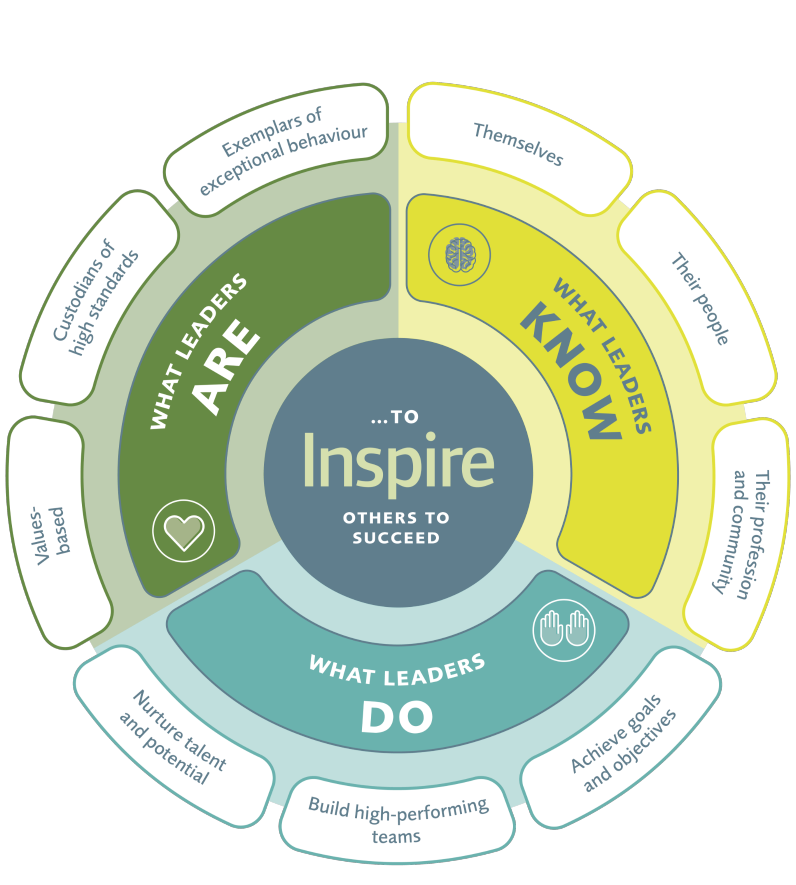
The Three Pillars of Inclusive Leadership
What Leaders ARE
What Leaders KNOW
What Leaders DO

Who is the Framework For?
The IELF is designed for every single member of our educational community. Whether you are a teaching assistant nurturing a child’s emotional wellbeing, an estates or finance colleague ensuring operational systems run smoothly, a classroom teacher taking on subject leadership, or an executive shaping strategic direction, everyone exerts a vital influence every single day.
Navigating the Continuum of Influence
We fundamentally believe that leadership is not a rank, a job title, or a static destination. Instead, it is a fluid continuum of influence where every single role exerts a vital impact. Whether you are managing your own daily practice in the classroom or setting the vision for a family of schools, your actions matter.
As your experience grows and your scope expands, you move dynamically across five key stages of influence:
Stage 1: Self-Leadership (The Foundation of Personal Impact)
Stage 2: Team Leadership (Leading Through Collaboration)
Stage 3: Operational Leadership (Leading Systems and Processes)
Stage 4: Strategic Leadership (Leading the Organisation)
Stage 5: System Leadership (Leading the Wider Community)
Crucially, as we move through these stages, we never leave the previous ones behind. System leaders must still practice self-leadership every single day, and self-leaders will often step up to guide teams.

The IELF is not meant to sit on a shelf; it is a living toolkit designed to support personal reflection, professional growth, and collective action across our schools.